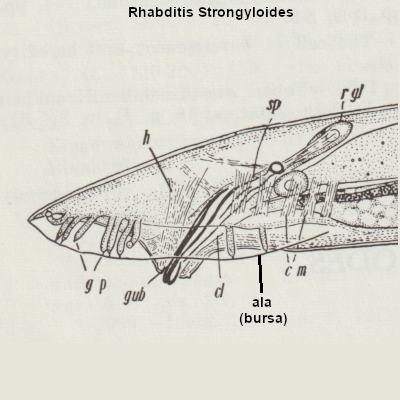
- ala (pI. alae) / bursa
-
thin, cuticular projection or fin, running longitudinally, usually lateral or sublateral, frequently paired cervical alae confined to the anterior end
- amixis
- Reproduction that normally proceeds without fertilization, although mixis is still possible.
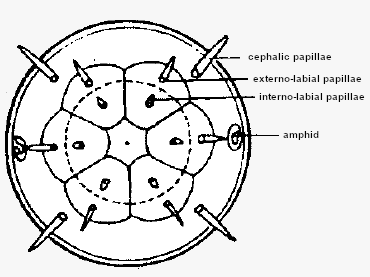
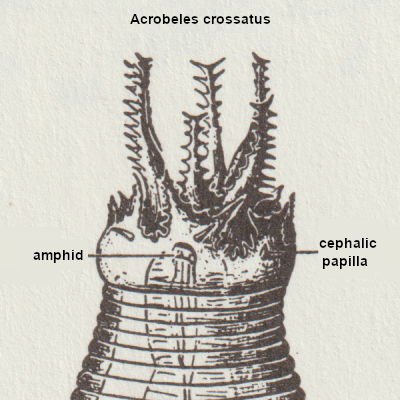
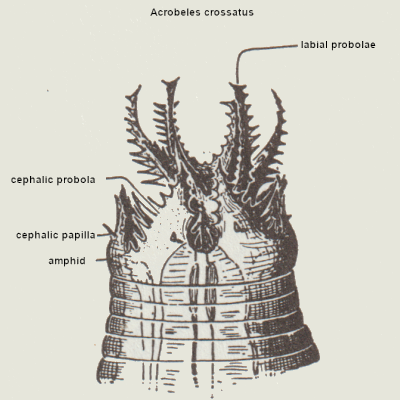
- amphid
-
One of two chemosensory/secretory structures on the anterior end of nematodes, located midlaterally or slightly dorsosublaterally. The amphids of many soil nematodes are very small and inconspicuous, while they are often distinct in aquatic nematodes.
- amphidelphic
- Female reproductive system with two branches diverging in opposite directions from the vagina.
- amphimixis
- Reproduction through cross fertilization.
- anus
- The exit opening of the digestive tract. It is usually a curved slit, and sometimes a tiny pore.
- apomixis
- Reproduction that never involves fertilization.
- automixis
- Reproduction through self-fertilization.
- basal bulb
- The swollen most posterior part of the pharynx is also referred to as the end bulb or, in some cases, the gland bulb. In Rhabditina and Cephalobina, the basal bulb is distinctly spherical to pyriform and contains three finely striated transverse valves, sometimes referred to as butterfly valves.
- basal lamina
- A skinny extracellular layer surrounds or supports epithelial cells, usually only visible with electron microscopy.
- buccal capsule
- The cuticle of the stoma, the lining of the digestive tract, between the mouth opening and the beginning of the pharyngeal corpus.
- buccal cavity
- The lumen of the stoma, which is the cavity of the digestive tract, is surrounded by the opening of the mouth, the beginning of the pharyngeal corpus, and the buccal capsule.
- bursa
- The bursa is a sucker- or cap-shaped cuticular structure found at the male's posterior end. It consists of two cuticular flaps, wings, or alae which together form the velum. The bursa can be either leptoderan or peloderan and often includes genital sensilla modified into rays. It is termed "open" if the two wings do not join before the cloacal opening and "closed" if they do.
- caudal alae
- see –bursa
- cheilostom
- The foremost section at the front of the stoma, enclosed by the lips' cuticle and (if present) labial probolae.
- cloaca
- The cloaca is an internal cavity located at the junction of the digestive and male reproductive systems. In most male nematodes, it contains spicules and a gubernaculum.
- convergent evolution
- The expression of characters that are similar as a result, not of a shared evolution, but due to separate evolutionary events
- corpus
- The anterior part of the pharynx proper, i.e. the anteriormost region in which the lumen has a triradiate cross-section that is not triangular but more or less Y-shaped.
- cuticle
- The extracellular layer(s) covering the cells of the body wall and lining parts of the digestive tract.
- deirid
- A sensory structure in the lateral field , usually located near the basal bulb . It is often papilliform in males and cryptic (i.e. invisible even with SEM) in females.
- determinate cleavage
- Development in which the destiny of each cell is determined early in development and these early cells are not readily adaptable to an alternate destiny.
- didelphic
- Female reproductive system with two (apparently) functional ovaries.
- endotokia matricida
- Internal hatching of eggs and development of juveniles, resulting in the death of the parent animal.
- entomopathogenic
- Life style characterized by the transmission of bacteria fatal to an insect host, followed by nematode repoduction inside this dead insect.
- entomophilic
- Life style characterized by parasitizing insects.
- esophagus
- Also known as a pharynx. The anterior major organ in the digestive system. It often has a triradiate lumen , is bounded by its own basal lamina , and is of mixed ectodermal and mesodermal origin. The pharynx is often wholly or partly muscular because it usually acts as a pump that sucks food into the mouth and transports it into the intestine.
- phasmid
- A sensory/secretory opening on each side of the body, usually (but not always) located midlaterally on the tail. In male nematodes, SEM is often required to distinguish the phsmid from genital papillae . Papillae
- phytoparasite
- Life style characterized by parasitizing plants
- plant parasite
- Life style characterized by parasitizing plants
- postvulval sac
- A blind sac extending posteriorly from the vagina in many (but not all) prodelphic-monodelphic female nematodes. Also called the postvulval uterine branch (PUB) or postvulval uterine sac (PUS). It is assumed to be a rudimentary posterior uterus, although its cell structure and texture usually differs from that of the anterior uterus.
- predator
- Life style characterized by feeding on small animals such as other nematodes.
- probola
- One of two types of cuticular processes projecting anteriorly from the lip region in a tri- or hexaradiate pattern of symmetry. Probolae are purely cuticular and contain neither nerve nor muscle cells. They appear to serve as scoops, brushes or flow guides with which bacteria are collected and diverted towards the mouth while the nematode moves through the soil.
- procorpus
- In species with a median bulb , the slender region of the phrayngeal corpus that lies anterior to the median bulb. In species without a median bulb, this term can be used to denote the anterior part of the corpus homologous to the former case.
- prodelphic
- Female reproductive system directed anteriad from the vagina.
- pseudocoelom
- A body cavity that, unlike a true coelom, does not develop in the gastrula from a secondary invagination of the mesoderm. Rather it develops between the endoderm and ectoderm. In the adult it is considered to persist as a fluid-filled sac.
- pseudocoelomate
- Describing a group of phyla that are considered to have a pseudocoelom. Recent evidence suggests that this grouping is artificial and is not the product of shared evolution.
- pseudogamy
- Reproductive mechanism whereby sperm penetration stimulates completion of oocyte meiosis, but no fusion of occurs sperm and oocyte pronuclei.
- radius
- One of the three arms of the pharyngeal lumen on transverse section.
- ray
- A genital sensillum resembling a tube, usually incorporated in the wings of the bursa. It is often impossible to distinguish the phasmids from genital sensilla if a bursa is present, and the phasmids are then also counted as rays.
- rectum
- The cuticular exit of the digestive system leading to the anus .
- sensillum
- A sensory structure capable of receiving stimuli from the external environment. Nematodes have many different types of sensilla, depending on whether they e.g. protrude above the cuticle or not, or whether they have an external opening or not.
- seta
- A protruding sensillum that is longer than wide and often pointed, more or less resembling a microscopic hair. Most setae are assumed to be mechanoreceptors only, although some may have an adhesive function.
- spear
- A hollow needle-like structure in the stoma of some groups of nematodes, used for piercing food items and ingesting their contents.
- spermatheca
- A flexible sac or expansion of the female reproductive system. In amphimictic and hermaphroditic species, it serves as storage site for sperm. In parthenogenetic species, it presumably serves no purpose and is usually less clearly developed. The spermatheca may be difficult to see, especially when large oocytes or eggs are present.
- spicule
- One of (usually) two male copulatory organs in nematodes.
- stegostom
- The posteriormost part of the stoma , encircled by the anteriormost muscle and epidermis cells of the pharynx.
- stoma
- The entry region of the digestive system, between mouth opening and pharyngeal corpus . It consists of the buccal capsule and the buccal cavity , and can often be subdivided further by the presence of various sclerotizations, or on the basis of surrounding cell types.
- (stomato)stylet
- A spear assumed to be derived from fusions of different parts of the stoma , and especially different parts of the buccal capsule . A stomatostylet occurs in the order Tylenchida and usually consists of three parts: an anterior cone, a central shaft and posterior knobs.
- total cleavage
- Early development in which the egg lacks a yolk so that it divides in its entirety to form an embryo.
- triploblastic
- Development which results in three germ layers: ectoderm, endoderm and mesoderm.
- uterus
- That part of the female reproductive system where the egg shell is formed. In amphimictic species, it usually extends from the point of fertilization of oocytes to the vagina.
- vagina
- The cuticular channel connecting the female reproductive tract(s) to the vulva.
- vulva
- The female genital opening, usually shaped as a transverse slit, a pore or a longitudinal slit.
- XXXXX
- XXXXXXXXXXXXXXXX
Image pop up!
Hover over the buttons for an image to appear. Clicking the buttons will do nothing, it's just easier to hover over a button.